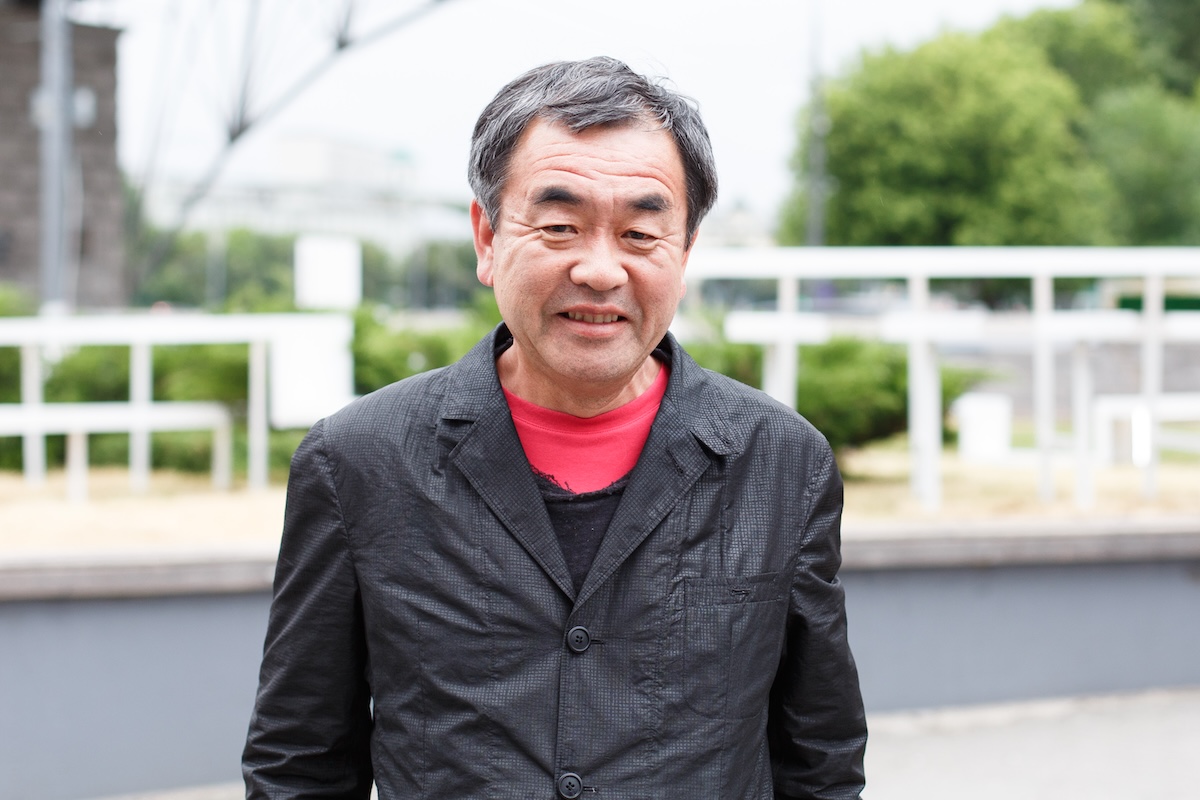
Kengo Kuma is the most recognizable Japanese architect working today. He founded Kengo Kuma & Associates in 1990, and the firm now runs studios in Tokyo, Beijing, Shanghai, and Paris with completed projects in more than 20 countries. TIME named him one of the 100 most influential people in the world in 2021, the only architect on that year’s list.
Kuma works against the heavy, monumental style that dominated twentieth-century architecture and calls his approach “anti-object,” as he wants his buildings to settle into their surroundings rather than stand apart from them. He breaks large forms into small parts, wraps them in wooden louvers and lattices, and leans on natural materials like cedar, bamboo, stone, and washi paper. The result feels soft and warm, where most large buildings feel hard and cold.
Tokyo is the best place in the world to see this work in person. Kuma has designed museums, a stadium, cafes, a train station, and a kabuki theater across the city, and most of them are free or cheap to visit.
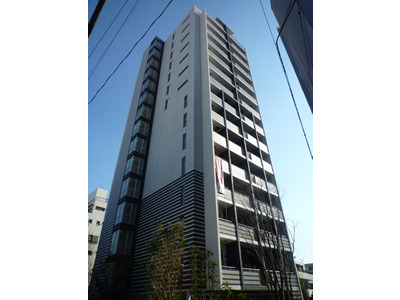
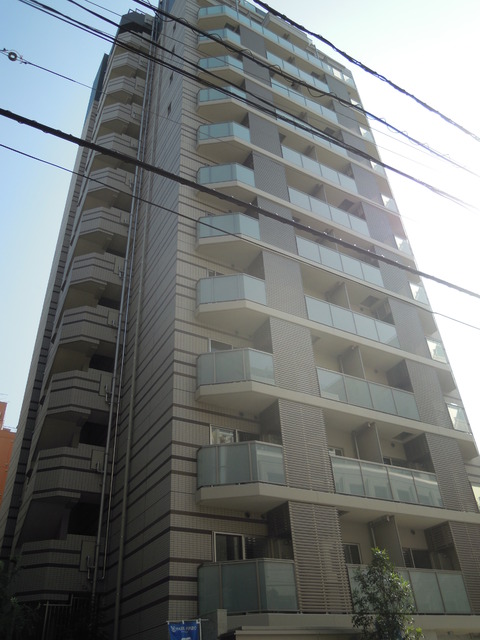
He also offers something the other big names in global architecture rarely do. You can live in a Kengo Kuma building. Several luxury residences in Tokyo’s most desirable neighborhoods carry his design, from rental apartments in Daikanyama to record-priced condominiums in Akasaka.
The Best Kengo Kuma Buildings in Tokyo
The buildings below run across almost every category Kuma works in, from a national stadium to a pineapple-cake shop, and they sit in some of the most desirable parts of the city. Most are free or cheap to enter, and several stand close enough together to be covered on foot in a single afternoon.
We start with his most famous work and move through the museums, shops, and public buildings you can visit today.
1. Japan National Stadium
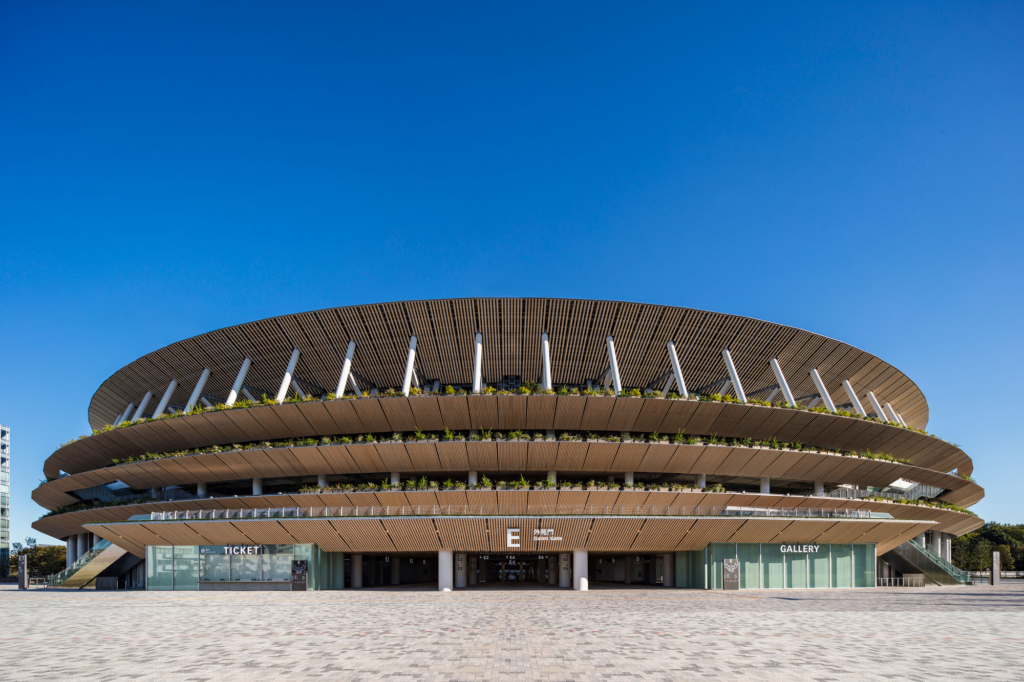
This is Kuma’s most famous building, and for most people, it is their first encounter with his work. He designed the roughly 68,000-seat stadium for the Tokyo 2020 Olympics as a joint venture with Taisei Corporation and Azusa Sekkei, after the government scrapped an earlier Zaha Hadid design over its cost.
The layered eaves use timber from all 47 Japanese prefectures, and Kuma kept the height low so the stadium would blend into the greenery of the neighboring Meiji Shrine grounds. He drew the form from the wooden pagoda at Horyu-ji temple.
You can walk the exterior any time, and paid interior tours run on a set schedule. The stadium sits in Kasumigaoka near Sendagaya, on the edge of the Aoyama and Gaien residential corridor.
2. Nezu Museum

The Nezu Museum in Minami-Aoyama is the single best stop for understanding what Kuma is trying to do. He rebuilt the museum, which holds industrialist Nezu Kaichiro’s collection of pre-modern Japanese and East Asian art, around a long bamboo-lined approach under a deep overhanging roof. The walk strips away the noise of the Omotesando shopping street before you reach the galleries.
Floor-to-ceiling glass connects the collection to a 17,000-square-meter Japanese garden with a cafe. Admission runs around 1,100 to 1,500 yen, the museum closes on Mondays, and it is an eight-minute walk from Omotesando Station.
3. Suntory Museum of Art
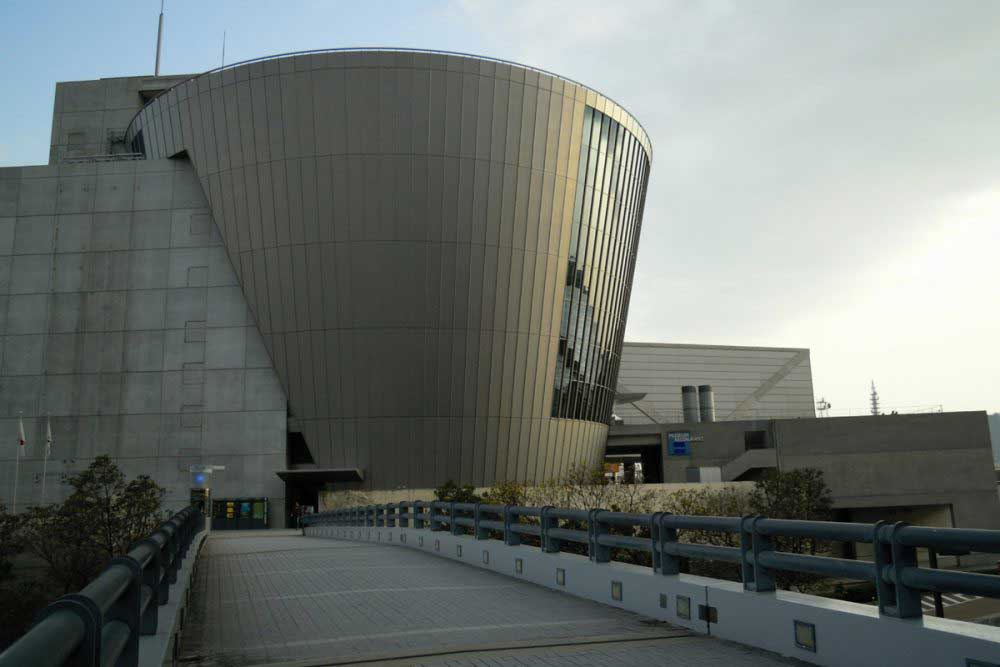
Kuma designed the Suntory Museum of Art inside the Tokyo Midtown complex in Roppongi as what he called an “urban living room.” The facade uses vertical white ceramic louvers that echo the pottery in the collection, and the interior mixes wood, washi, and white-oak flooring reclaimed from whiskey barrels.
The museum forms one corner of the Roppongi Art Triangle alongside the National Art Center and the Mori Art Museum. It sits at the center of one of Tokyo’s most expensive residential and retail districts.
4. Sunny Hills Japan, Minami-Aoyama
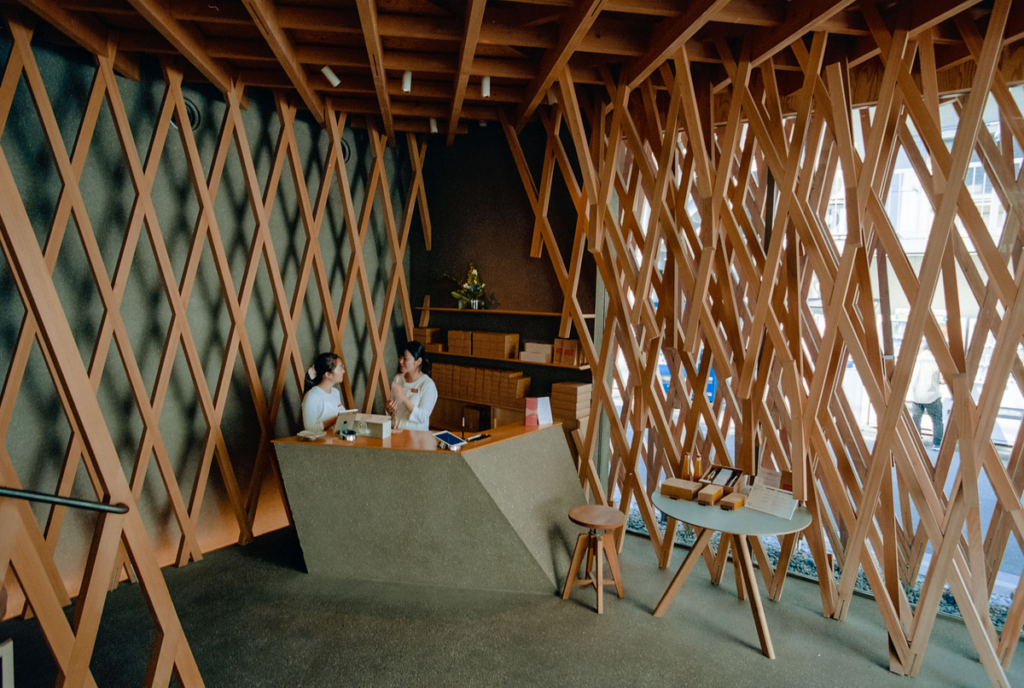
Sunny Hills is a small Taiwanese pineapple-cake shop built as a basket-like cloud of interlocking cedar beams. Kuma used the traditional jigoku-gumi joint system, an interlocking method that needs no nails or glue, to create what he described as a forest in the town.
The shop sits on a quiet residential street in upscale Aoyama, and it is free to enter. A visit usually comes with a sample of cake and tea.
5. Starbucks Reserve Roastery Tokyo
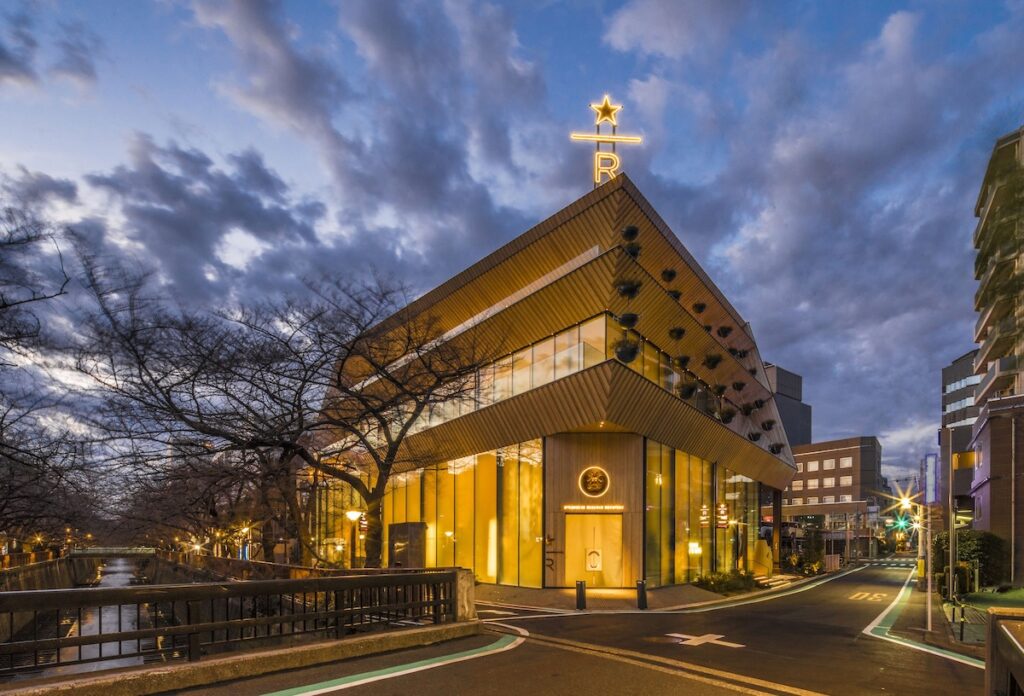
The Starbucks Reserve Roastery in Nakameguro was the largest Starbucks Reserve Roastery in the world when it opened in 2019, spread across four floors and roughly 2,966 square meters.
Kuma designed the exterior with a timber-fin facade and engawa-style terraces that overlook the cherry trees along the Meguro River. Inside, you find a wood-tiled ceiling inspired by origami, a 55-foot copper coffee cask, a Princi bakery, a Teavana tea bar, and a cocktail bar.
Entry is free, and the building turns into one of the best cherry-blossom spots in the city each spring. It anchors Nakameguro, one of the neighborhoods foreign residents gravitate toward most.
6. Asakusa Culture Tourist Information Center
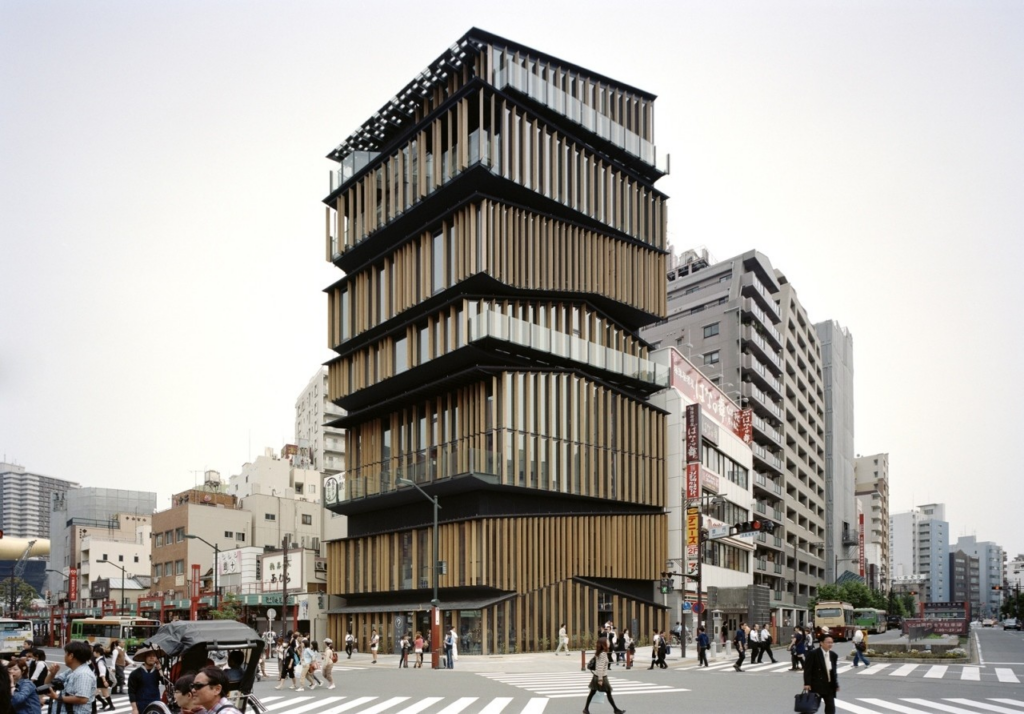
This eight-story building looks like a stack of seven slanted-roof wooden houses, and it stands directly across from the Kaminarimon gate at Sensoji temple. Kuma hid the mechanical equipment inside the voids between the sloped roofs and wrapped the whole structure in wooden louvers set at irregular intervals.
A free observation deck and cafe on the eighth floor give you a clear view over Sensoji, the Nakamise shopping street, and Tokyo Skytree. The center opens daily and costs nothing to enter, which makes it one of the easiest Kuma buildings to fit into a trip.
7. Kabukiza Tower
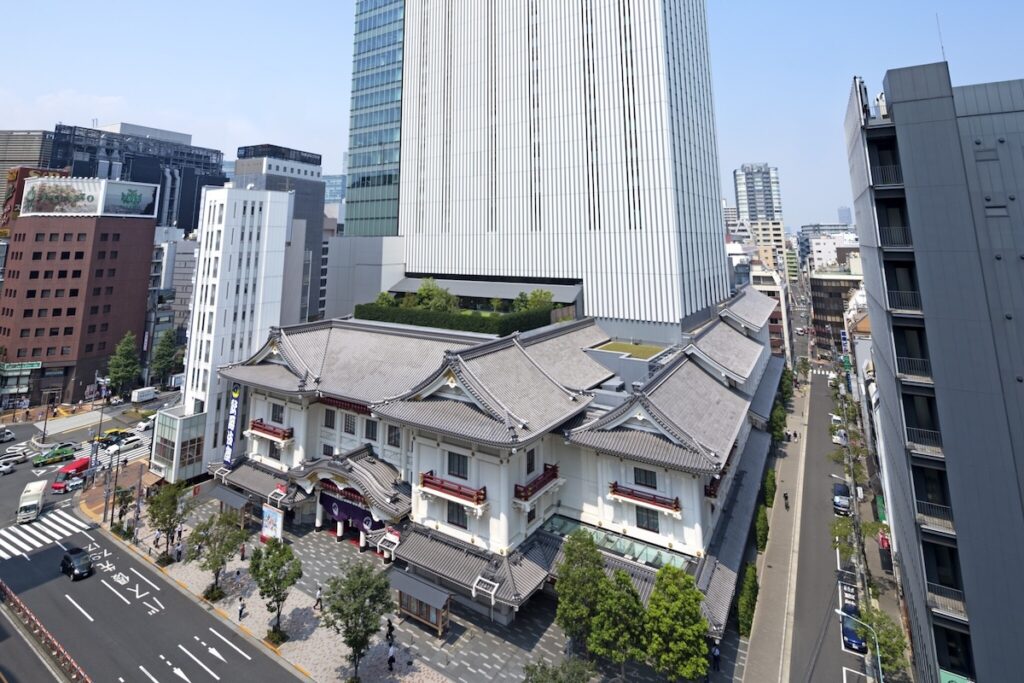
Kuma rebuilt the Kabukiza, Tokyo’s main kabuki theater in Ginza, as the fifth version of the building in 2013, working with Mitsubishi Jisho Sekkei. He preserved the ornate Azuchi-Momoyama-style theater facade with its curved gable and tiled roofs, then set a 145-meter office tower behind it on a column-free truss so the historic frontage reads as untouched from the street.
A free rooftop garden, a gallery, and Kuma’s own bamboo-lined Jugetsudo tea shop sit above the theater. The building connects directly to Higashi-Ginza Station in Tokyo’s most prestigious shopping district.
8. Takanawa Gateway Station
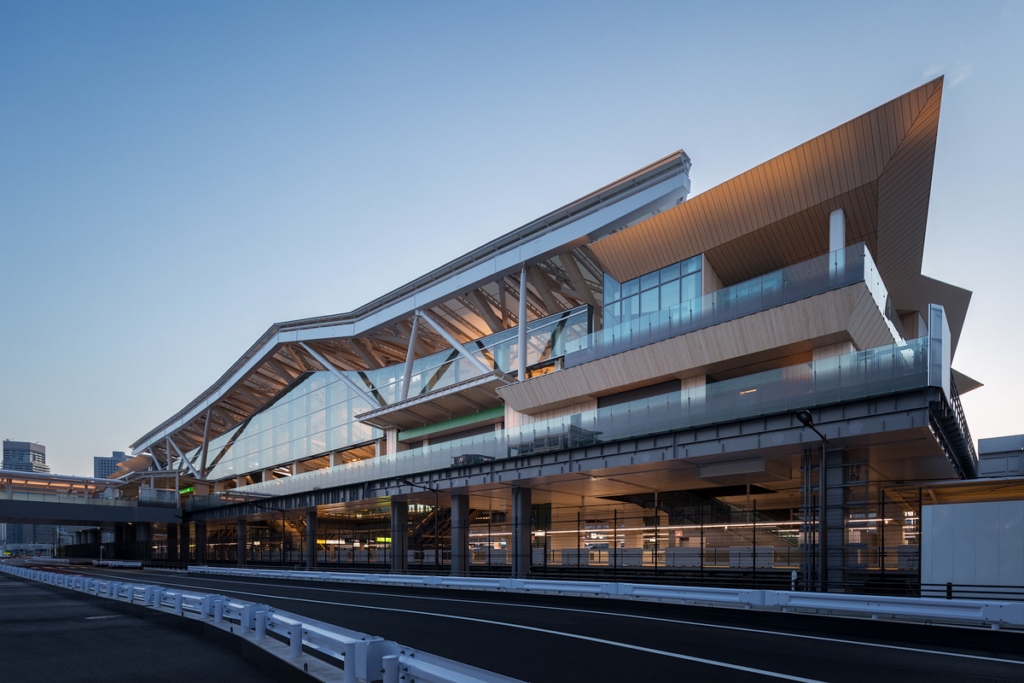
Takanawa Gateway is the first new station on the Yamanote Line in 49 years, and Kuma gave it a folded, origami-like roof of steel and laminated cedar that recalls a paper shoji screen. Cedar from Fukushima Prefecture lines the interior.
The station is the centerpiece of the large Takanawa Gateway City redevelopment in Minato, which is opening in phases through 2026 and which makes the Shibaura and Shinagawa area one of the most closely watched parts of the Tokyo property market. The station is free to pass through, and it already has shops and cafes around the concourse.
9. One@Tokyo
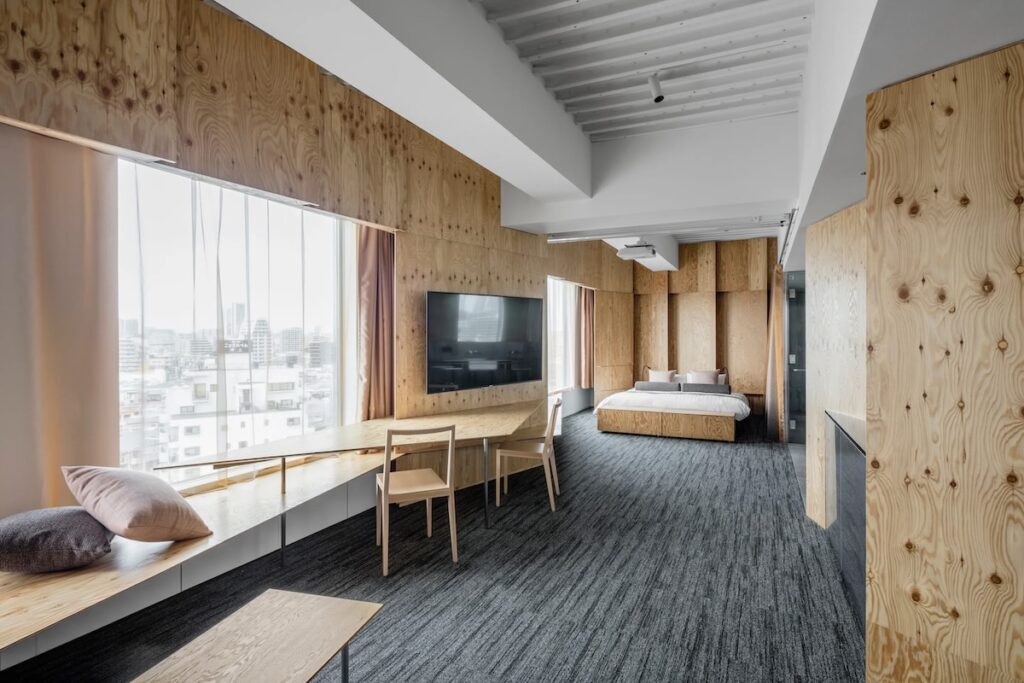
One@Tokyo is the easiest way to sleep inside a Kuma building without buying property. He designed both the exterior and the interior of this design hotel in Oshiage, three minutes from Oshiage Station and a short walk from Tokyo Skytree.
The facade uses extruded cement panels and wooden screens that nod to the small factories that once filled the area, and the rooftop terrace looks straight at Skytree. Rooms are reasonably priced for what they are, which makes the hotel a low-cost way to experience his work overnight.
Kengo Kuma Buildings You Can Live In
Kuma is unusual among architects of his stature because a number of his Tokyo residences are open to ordinary buyers and renters. The level of his involvement varies from project to project, and that difference is worth understanding before you start shopping.
On most of the for-sale condominiums below, Kuma handled the design supervision of the facade and shared spaces while a larger firm served as the executive architect. On the rental and bespoke projects, his authorship runs deeper and that distinction affects how much Kuma you are paying for.
1. Forestgate Daikanyama
Forestgate is the residence with the strongest Kuma fingerprint, since his firm led the basic design rather than just supervising it. The ten-story mixed-use complex opened in October 2023 one minute from Daikanyama Station, with shops and shared offices on the lower floors and 57 rental apartments above.
Units run from about 60 to 310 square meters, and reported rents stretch from 500,000 yen to 4,000,000 yen per month. The building reads as a set of wooden boxes wrapped in louvers with planted gaps between them. It sits in Daikanyama, one of the most exclusive and walkable enclaves in the city.
2. Plastic House
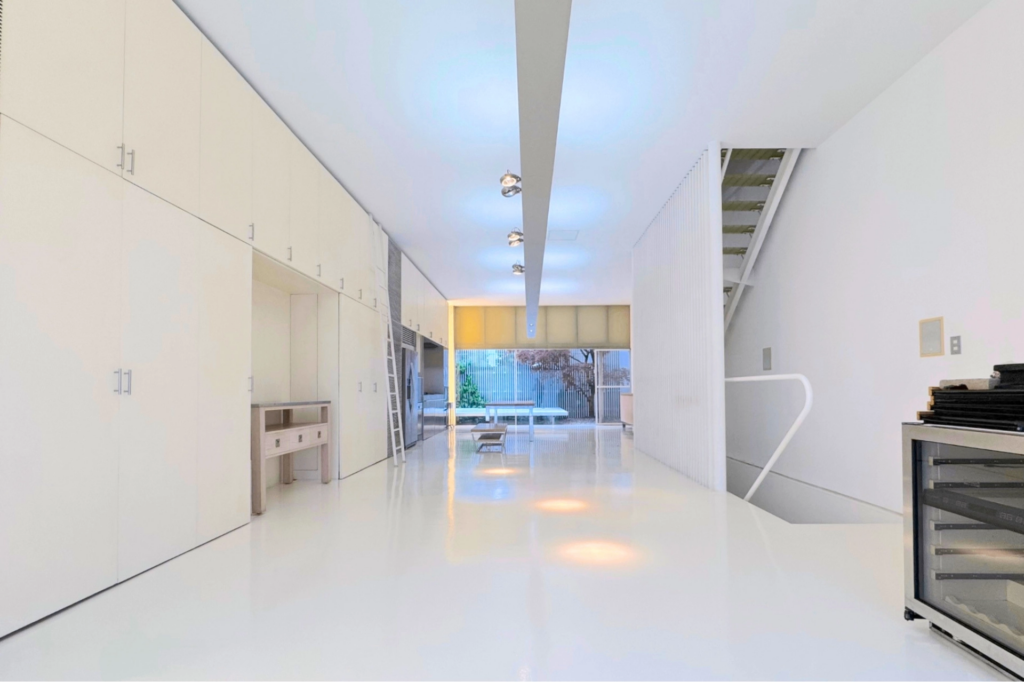
Plastic House is one of the most unusual buildings on this list, and it is also currently available for rent.
Kuma designed it in 2002 as a home for a writer and her photographer son, and he built it almost entirely from FRP, a four-millimeter fiberglass-reinforced plastic. The material looks like rice paper in some light and like bamboo in others, which lets him carry the soft translucency of a traditional paper screen into a modern city house.
A ground-floor open-air space works as a roofless tearoom, and the roof terrace serves as an outdoor studio.
The unit available for rent is a three-bedroom home of just over 250 square meters in Meguro Ward, with a corner-room layout, a balcony, a terrace, a roof deck, and a private garden. The house sits a short walk from Yutenji and Naka-Meguro stations on the Tokyu Toyoko and Hibiya lines.
That puts you in the same Nakameguro area as the Starbucks Reserve Roastery, in a house Kuma designed in full rather than a tower he only supervised.
3. Park Court Akasaka Hinokicho The Tower
This 44-story tower next to Hinokicho Park and Tokyo Midtown is the highest-profile Kuma condominium in Tokyo. Mitsui Fudosan Residential developed it in 2018, with Kuma designing the facade and crown and Nikken Sekkei serving as the base architect.
Prices made headlines. Units started around 155.6 million yen for a one-bedroom and ran up to 1.5 billion yen for the penthouse, among the highest figures for any apartment sold in Japan since the bubble era. The Akasaka location puts residents inside one of the city’s prime luxury districts.
4. Branz Chiyoda Fujimi
Tokyu Land completed this 18-story Branz flagship in Chiyoda in late 2024 under Kuma’s design supervision. The roughly 65-unit tower sits near Kudanshita and Iidabashi with views toward Yasukuni Shrine and the Chidorigafuchi moat. Its facade takes the old stone walls of Edo Castle as its theme, using a thin stone-and-glass-fiber composite.
The building set a price record for the Branz series, which signals how much a Kuma name now adds to a development’s positioning.
5. Proud Jingumae
Nomura Real Estate built Proud Jingumae as the top tier of its Proud line, with Kuma supervising the design. The base-isolated residence sits a few minutes from Harajuku and Meiji-Jingumae on an elevated plot, with private elevators, a bronze-toned facade that echoes the copper of nearby Meiji Shrine, and concierge service tied to the Palace Hotel.
The developer marketed it openly to international residents and investors, which makes it one of the more accessible Kuma buildings for a foreign buyer.
6. The Kita
The Kita is the most exclusive Kuma residence in the city and one of his most hands-on, since he designed both the structure and the interiors. The four-story building holds just 12 units on the edge of Yoyogi Park, and the Vancouver developer Westbank built it.
A filigree of treated metal louvers covers the main facade. This is Kuma residential design at its most bespoke, sold to a very small group of buyers.
7. Brillia Tower Ikebukuro
Brillia Tower Ikebukuro was Japan’s first building to combine a city government office and private condominiums in a single high-rise. Kuma’s firm co-designed the 49-story tower with Nihon Sekkei for Tokyo Tatemono in 2015, wrapping it in greenery and solar panels so it reads like one giant tree.
The 432 residences sold in a wide range, from roughly 34 million yen to 210 million yen, which makes this the most attainable entry point into a Kuma building for most buyers.
Kengo Kuma’s Major Buildings Outside Japan
Kuma’s reach extends well beyond Japan, with completed buildings across Europe, Asia, and North America.
The projects below are the ones most worth knowing, either because they marked a turning point in his career or because they show how he adapts his wood-and-stone language to a setting far from Tokyo. The list closes with a London commission that will become the largest project of his career.
1. V&A Dundee, Scotland
The V&A Dundee, which opened in 2018, was Kuma’s first building in the United Kingdom and remains the only design museum in Scotland. He built its cliff-like, curving walls from around 2,500 precast stone panels, drawing the shape from the rugged cliffs along the northeast Scottish coast.
A large public foyer works as a free living room for the city, and a torii-inspired opening cuts through the structure toward the River Tay. TIME named the museum one of the world’s greatest places in 2019.
2. China Academy of Art Folk Art Museum, Hangzhou
This museum, finished in 2015, sits on a former tea-field hillside on the China Academy of Art campus. Kuma let its tiled, village-like roofs cascade down the slope so the building follows the land instead of flattening it.
He hung thousands of old roof tiles on wires across the facade, which filter the sunlight and tie the new building to the recycled materials of the villages around it.
3. Odunpazari Modern Museum, Turkey
Kuma designed this museum in Eskisehir, completed in 2019, as a cluster of stacked and interlocked timber boxes. The shifting blocks reference the town’s history as a wood-trading center and the timber houses in the old quarter around it.
The stacked volumes create a small street-like route through the galleries, and a tall central atrium draws daylight down into the heart of the building.
4. Portland Japanese Garden, Oregon
The Cultural Village at the Portland Japanese Garden, completed in 2017, was Kuma’s first public commission in the United States. He arranged a set of pavilions with deep, layered roofs in the style of a monzenmachi, the small town that traditionally grows up at the gates of a Japanese temple.
Green roofs and local stone tie the buildings into the forested hillside of Washington Park. The project raised Kuma’s profile in North America and led to later American commissions.
5. H.C. Andersen House, Odense, Denmark
Kuma won a 2016 international competition, beating firms that included BIG and Snohetta, to design this museum dedicated to the fairy-tale author Hans Christian Andersen. It opened in 2021 in Odense, the Danish city where Andersen was born, next to the house of his birth.
He drew the design from Andersen’s story The Tinderbox, in which a tree reveals a hidden underground world. Roughly two-thirds of the 5,600-square-meter museum sits below ground, and a trio of cylindrical, timber-latticed pavilions rises into a maze-like garden above. The building shows clearly how Kuma carries his natural-materials approach into a European setting.
6. National Gallery Wing, London
In April 2026, Kuma’s firm won the competition to design a new wing for the National Gallery in London, working with the British firms BDP and MICA. The commission is the gallery’s largest expansion in its 200-year history and forms part of a 750-million-pound project called Domani.
The design uses stepped massing clad in striated Portland stone, with a roof garden and new public spaces that link Leicester Square and Trafalgar Square. The wing will hold the gallery’s expanded collection of paintingshouse the gallery’s expanded collection of paintings made after 1900, and it is scheduled to open in the early 2030s, making made after 1900, and it is scheduled to open in the early 2030s, which will make it the biggest project of Kuma’s career.
Find Your Home in Kengo Kuma’s Tokyo
Kuma-designed residence puts you inside a recognized piece of architecture and inside a neighborhood with strong, lasting demand. Foreign buyers can purchase property in Japan without a residency requirement, and options range from rental apartments at Forestgate Daikanyama to for-sale condominiums across central Tokyo.
Tokyo Portfolio works with international buyers and renters who want a home in the most sought-after neighborhoods in Tokyo. We help you find and evaluate properties, including the architect-designed buildings covered here, and we guide you through pricing, availability, and the full purchase or lease process from the first viewing to handover.
Contact us to start your search, and we will match you with a home that fits both the neighborhood you want and the way you want to live.